
The “No-Panic” Baby First Aid Kit: A Doctor-Mom’s Essential Guide
The first time your baby feels like a literal toasted sandwich, you will probably lose your mind. I’m a Medical Officer, I’ve seen a thousand fevers in the wards, and yet, when my own little one spiked a temperature, I still spent ten minutes staring at the thermometer like it was written in ancient hieroglyphics.
If you’re a first-time parent, your “medical bag” shouldn’t just be a graveyard of half-used diapers and mystery crumbs. You need a baby first aid kit that actually works when the 2 AM panic hits.
Why You Can’t Just Use Your Own First Aid Kit
You might be tempted to just grab a stray band-aid and some adult ibuprofen, but babies are not just tiny humans; they are physiologically unique. From their skin permeability to their metabolic rates, they need specific gear. Adult medications and tools can be dangerous, or at the very least, wildly inaccurate for a 6kg human. This is why having dedicated baby first aid kit essentials is non-negotiable.
The Fever Fighters: Preventing the Dreaded Febrile Fit
When your baby has a high-grade fever, the goal isn’t just “comfort”—it’s about safety. As a doctor, my biggest concern with spikes is the febrile fit (febrile seizure). While these are usually harmless and don’t cause brain damage, seeing your baby shake uncontrollably is a trauma no parent wants.
The Accurate Thermometer
This is a must-have in your baby first aid kit. You need two types. A rectal thermometer is the medical gold standard for accuracy under 3 months. For older babies, an infrared forehead scanner is great for quick checks, but if they feel hot and the scanner says they’re fine, trust your hand and re-check with the digital stick.
Suppositories: The Secret Weapon
Many babies absolutely refuse oral meds. They will spit it back at you with the force of a garden hose. This is why Paracetamol suppositories are a non-negotiable in my kit. They work fast and bypass the “spit-up” struggle.
Kool Fever Patches vs. Tepid Sponging
Tepid sponging is the classic advice, but it often just makes the baby cold, grumpy, and wet. Cooling gel patches (like Kool Fever) are brilliant. They stick to the forehead, stay cool for hours, and avoid excessive water drenching that soaks the baby’s clothes.
I know from experience that at night, your brain is 50% panic and 50% caffeine. To help you stay organized, I’ve created this Emergency Medicine & Fever Tracker. It includes a weight-based dosage cheat sheet and some Red Flags’s to watch out for. Click here to download the high-res version for your fridge or nursery!

The Snot Battle: Manual Aspirators & Sterimar
Babies are “obligate nasal breathers,” meaning they don’t know how to breathe through their mouths yet. A stuffed nose isn’t just annoying; it makes feeding nearly impossible because they can’t breathe and swallow at the same time.
The “Vacuum” Manual Aspirator
If the thought of sucking snot through a tube with your mouth makes you gag, the newer manual vacuum aspirators are your best friend. You use your hand to pull up a flange to create a vacuum. It’s cleaner, more controlled, and highly effective.
Saline as a Softener
Never suction a “dry” nose. It’s painful and can cause swelling. Use Sterimar baby spray or saline drops first. Think of this as the “softener” that makes the treasure inside easier to remove.
Monitoring SpO2: Don’t Wait Until They Turn Blue
We’ve all been there—creeping into the nursery at 2 AM to see if they are still breathing. In the medical world, we don’t want to wait until a baby shows cyanosis (turning blue) to realize they are in trouble.
• Owlet Dream Socks: Wearable monitors like the Owlet track oxygen levels (SpO2) and heart rate. While they aren’t a replacement for safe sleep, for a sick baby with a cough, seeing that 98% oxygen level on your phone can be the difference between a restful night and a panicked trip to the ER.
This is definitely a very nice thing to have in your baby first aid kit.
Tummy Drama: The Gripe Water Controversy & ORS
• The Gripe Water Debate: Many swear by it for colic, but as a doctor, I stay cautious. Some brands contain high sugar or even alcohol in older formulations. There is limited clinical evidence it works, so always check the ingredients and consult your pediatrician.
• Oral Rehydration Salts (ORS): If your baby has diarrhea, ORS is essential. Crucial Tip: It must be diluted exactly as instructed on the packet. Incorrect dilution can mess with your baby’s delicate electrolyte balance.
The 6-Month Water Rule
A quick clinical reminder: water should generally only be given to babies above 6 months old. Under 6 months, they get their hydration from milk. The only exception is the tiny amount of water used to serve medicine if absolutely necessary.
Tools of the Trade: The “Doctor-Mom” Essentials
Your kit needs more than just meds. It needs the right “instruments” to keep things sterile and safe.
• Fine-Tip Tweezers: These aren’t for eyebrows. Use these to promptly and safely remove foreign bodies (beads, peas, Lego bits) from ears or noses. Pro-tip: If you can’t see the object clearly, stop. Poking it further in is an ER job. Check out my post on Baby-Led Weaning (BLW), and save yourself the stress from having to deal with food ending up in the nose or ears.
• Alcohol Swabs & Sanitizer: Every time you use your thermometer, tweezers, or nail scissors, you must clean them. Keeping a stash of alcohol swabs and hand sanitizer in the kit ensures you aren’t spreading germs while trying to heal them.
• Gauze & Bandages: For the inevitable “crawling-speed” knee scrapes and minor cuts.
• Topical Steroids: Keep a mild hydrocortisone on hand, but be careful—adult steroid strength is much too high for thin infant skin. Always use the pediatric-specific strength.
Dosage by Weight: The Only Safe Way to Medicate
One of the biggest mistakes parents make is dosing by age. Every baby is built differently! A “chunky” 6-month-old needs a different dose than a “petite” 6-month-old.
Standard Syrup Paracetamol Dosage (approx 15mg/kg):
• 5kg Baby: ~75mg (approx 3.1ml of 120mg/5ml suspension)
• 8kg Baby: ~120mg (approx 5.0ml of 120mg/5ml suspension)
• 10kg Baby: ~150mg (approx 6.2ml of 120mg/5ml suspension)
Always verify with your doctor or the packaging before administering. Because a worried mom is easily confused. Double check the medications and dosage. It’s also important to know that the same medicine can have different dosage. Syrup paracetamol is approximately 15mg/kg while suppository paracetamol is approximately 30g/kg.
Some Medications Are Not Recommended For Certain Age
Syrup ibuprofen is an alternative to paracetamol to break down a fever. However, it is generally not recommended to give to babies less than 6 months old or less than 7kg.
Hence, it is always important to consult a doctor before administrating any medication especially for the first time when you are unsure whether it would bring good or harm.
When Should You Actually Worry?
As a doctor, I want you to trust your gut, but here are the “Red Flags” that mean you skip the home kit and head straight to the hospital:
Lethargy: If they are floppy, won’t wake up for feeds, or seem “out of it.”
Respiratory Distress: Look at their chest. If the skin is pulling in between the ribs (retractions), they are working too hard to breathe.
Dehydration: Fewer than 4-6 wet diapers in 24 hours.
High Fever in Newborns: Any fever over 38°C (100.4°F) in a baby under 3 months is an automatic hospital visit.
Sleep helps with recovery! If your sick baby is struggling to rest, check out my guide on Newborn Sleep Mistakes Everyone Makes.
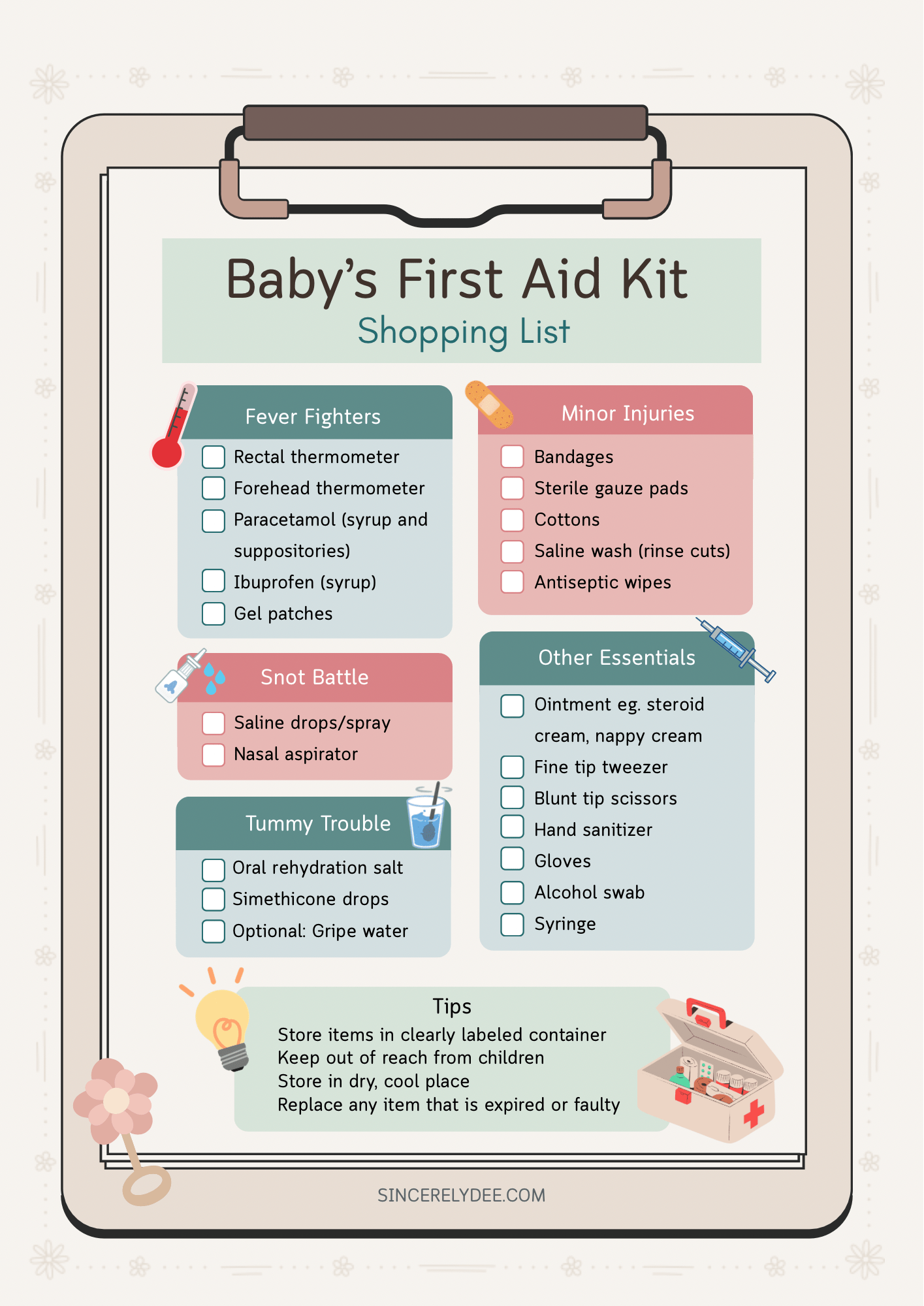
Ready to build your baby first aid kit? I’ve summarized everything we talked about into this Baby First Aid Kit Essentials Shopping List. You can tick these off as you go to ensure you don’t miss a single ‘Snot Battle’ essential. Grab your free copy here.
It doesn’t have to happen all at once but being prepared is 90% of the battle in staying calm.
I’ve shared what’s in my doctor-mom kit, but I want to know: What is the ONE item you absolutely cannot live without when your little one is under the weather? Leave a comment and help another new parent build their survival kit!
You Might Also Like: What to Feed a 6-Month-Old Baby – Simple Meals, Prep Tips & Free Planner
Sincerely,
Dee


